

What four slow weeks on a Croatian island did for my family
Eight months of planning, saving and excitement went into a family enrichment experience that changed the way we do life, both individually and as a family. It was money and time well spent, and well invested.
In June and July this year, my two daughters, their Dad, my partner Adam and some of our extended family, friends and I travelled to the island of Hvar, to a small town called Jelsa, for a worldschooling program called The Field School of Hvar.
It’s taken me a few months to put into words what actually happened. The effects are still being felt, and they’ve become part of how my family lives now in a way I didn’t fully expect.
“I also belong to the Field School of Hvar”
At the end of school term 3 this year back in Australia, my youngest daughter Savannah, aged 7 (nearly 8), recorded a reflection as a school project about her time at the field school. She remembered it in great detail:
“In Croatia, there is so much lavender, and they have lavender ice cream, lavender everything. We made lavender bouquets out of the lavender at the Field School.”
Savannah, aged 7
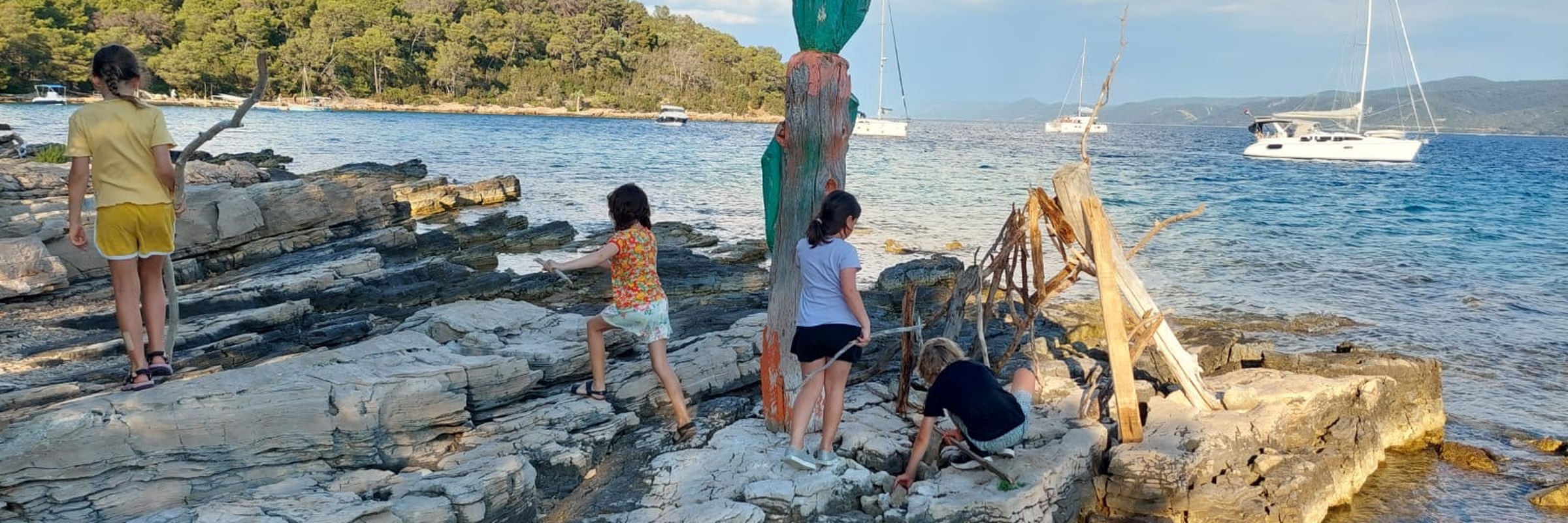
She talked about taking a boat to Bunny Island, named because it’s shaped like a bunny. She talked about sewing with ribbons she had dyed herself using flowers. She spoke about greeting her Australian class with “Dobar dan”, which is Croatian for good day, and explained that they learnt a song about being Dalmatian, “because we lived in the place called Dalmatia.”
Then she finished with the line I keep coming back to:
“I belong to my school, but I also belong to the Field School of Hvar.”
Savannah
She has claimed this experience as part of who she is. That gives me so much joy, because it’s the imprint I dreamed it would leave. When you’re in the middle of an experience like this, it’s hard to tell whether your children are really taking it in. Months later, you find out they were, and more deeply than you thought.
Learning through place, not just about it
The Field School is built on place-based learning. The island is the classroom, it’s a living, breathing curriculum. Lavender isn’t a picture in a book, it’s something you pick from the field garden you walk to each day, bundle, dry, smell in the school hub, and then taste in ice cream and kombucha (now that was delicious) from the local producers.
Colour isn’t a lesson on a worksheet, it’s flowers turned into dye and then into ribbon. Language isn’t vocabulary lists, it’s a song you sing with local children and a greeting you get to use at the bakery the next morning.
This felt familiar to me. I grew up on a farm in the Northern Rivers of NSW, where I learnt through the land, the seasons and the work. Watching my girls learn the same way on a Dalmatian island reminded me how much children absorb when they’re outside, using their hands, connected to where their food, colours and stories come from.
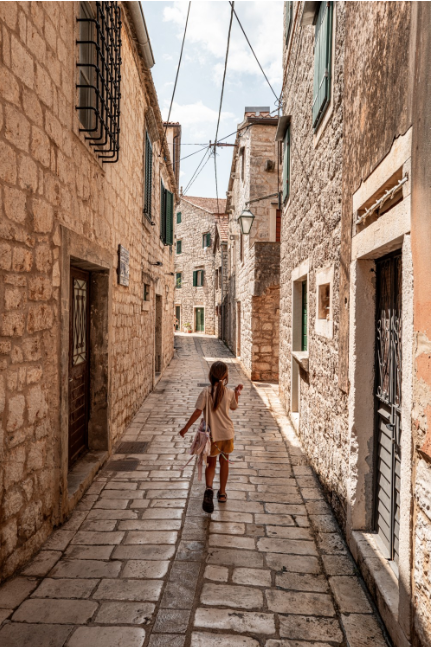
The term commonly used to describe this experience is worldschooling: learning through travel and experience. In this instance, nature and place became the curriculum and the learning method, because the learning is tied to a feeling, a smell, a friendship and a landscape. Savannah didn’t memorise facts about Croatia. She lived a small part of Croatian life, and she can still tell you all about it months later without any notes.
The gift of going slowly
Pomalo: slowly, slowly
The Dalmatians have a phrase for their way of life: pomalo, meaning slowly slowly, take it easy. Staying in one place for four weeks, we found out what it truly means.
Slow travel gives children (and parents) time to settle in. And once the novelty fades, curiosity takes over. Routines form around visits to the local farmers market, the walk to school, and the swim with their friends and the locals in the sea before lunch. Without screens, our girls filled their days with making, exploring, playing and conversations, learning the skills of global citizens along the way.
Human flourishing, seen in hindsight
I’ve spent more than 20 years designing events and experiences, both on and offline, for other people. Whilst I have had similar experiences of travel changing many parts of myself, it took being a participant with my own family, in a setting that provided the conditions, to fully understand what a well-designed experience can do.
Human flourishing isn’t something you can see in a holiday image or reel. It shows up later: a child who’s more confident with strangers, more curious about the world, more at ease outdoors, and who now says she belongs to a place on the other side of the world. Looking back, that’s the transformation. Not one big moment as such, but lots of small ones that added up to a different way of being.
That’s the real work of transformational travel. You can’t make change happen, but you can seek, find and create the conditions for it. We found that in the Field School of Hvar and the Croatian way of life.
The conditions for change
- Place-based, real-world learning
- Time and slowness
- Nature immersion
- Exploring the local culture
- Connection
- The space to be curious
Get those right, and growth takes care of itself.
Why do it as a family
I’ve worked closely with school and youth travel recently, in the more traditional sense. Travelling without parents builds independence, resilience and confidence in a way nothing else can, and every young person deserves that chance.
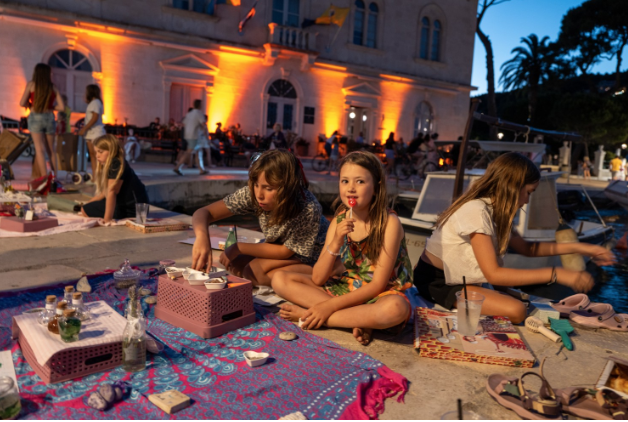
But there’s something extra in going as a family. When you share an experience, you also share the memories it leaves. We all fumbled through the language together. We all navigated the unfamiliar, the tiring days (because we stayed up until midnight in the old town with friends) and the little wins. Our girls saw us as learners too, getting things wrong and having a go anyway. And having extended family with us meant the girls shared it across generations.
That bonding doesn’t stop when the trip ends. “Remember Bunny Island?” now comes up at our dinner table. The experience has become part of our family story, and you can’t build that by sending your kids off alone.
Shaping futures, and global citizens
When we talk about raising global citizens, we tend to picture passports full of stamps. I think it’s really about something quieter: a child’s ease with the unfamiliar, respect for other ways of living, and the confidence to step into a new place and find their place in it.
Worldschooling builds that through adaptability, empathy, curiosity, a feel for other languages, and a connection with nature and community. Those aren’t extras. They’re what will shape how our children deal with an increasingly changing world of AI and innovation, and they will influence the futures our children go on to create.
What I know now
So, what happened when my kids went without screens for four weeks?
The space the screens left behind filled up with lavender creations, ribbons dyed from flowers, a song in Croatian and new friends from the other side of the world. And it filled up with us: slow mornings, the opportunity to work remotely, long dinners and conversations we rarely make time for at home.
We went to Hvar hoping to show our children the world. We came home realising we’d given them something bigger.
A screen can show a child parts of the world. Only living in it can show them they belong there.
Maybe that’s what being a global citizen really means. It isn’t about having seen everywhere. It’s knowing you can belong wherever you are. When children discover that with their family beside them, they don’t just carry the place home with them. They carry each other.
What this means for the experiences we design
As an experience designer, Hvar taught me something I couldn’t have learnt from the other side of the brief.
Transformation isn’t the product. It’s what happens when people are given the right conditions: time to slow down, a real connection to place, hands-on learning, people to share it with, and the space to be curious.


-
I also belong to the Field School of Hvar
Four slow weeks on Hvar, a worldschooling program and one seven-year-old’s reflection: what place-based learning taught my family about belonging and ...
-
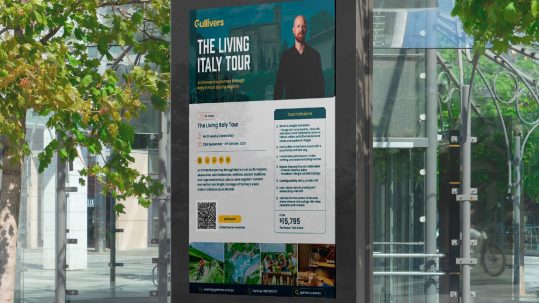
Case Study: Building a Marketing Function from the Ground Up: Gullivers Australia
How Gullivers Australia went from no marketing team to a new brand, eCommerce site, CRM and owned-media publication in under two years. A case study....
-

Attention, Algorithms & Attraction for Wellness Brands
The triple factor (attention, algorithms, and attraction) is reshaping wellness marketing. Here’s how to cut through the noise and build a brand clien...